The pause that changes everything
Senior leaders rarely lack insight — but they often feel they lack time to make sense of it. And our systems reinforce that: we reward speed, decisiveness and delivery, but rarely the pause to reflect.
And yet, it can make all the difference.
A Harvard Business School study found that employees who spent just 𝟭𝟱 𝗺𝗶𝗻𝘂𝘁𝗲𝘀 𝗮 𝗱𝗮𝘆 𝗿𝗲𝗳𝗹𝗲𝗰𝘁𝗶𝗻𝗴 on what they learned performed 𝟮𝟯% 𝗯𝗲𝘁𝘁𝗲𝗿 after ten days than those who didn’t.
Reflection isn’t time away from progress — it 𝙘𝙧𝙚𝙖𝙩𝙚𝙨 progress.
I write a few lines at the end of most days, and have done so for as long as I can remember. I don’t plan what to write, or analyse what I’ve written. Some days it’s a sentence about something I’m grateful for. Other days it’s frustration, or a half-formed thought that probably makes no sense.
But it always leaves me lighter, calmer, more grounded.
Still, reflection doesn’t come easily to most of us.
We don’t make space for it, or we don’t know where to begin. We confuse it with overthinking, or worry it won’t lead anywhere useful.
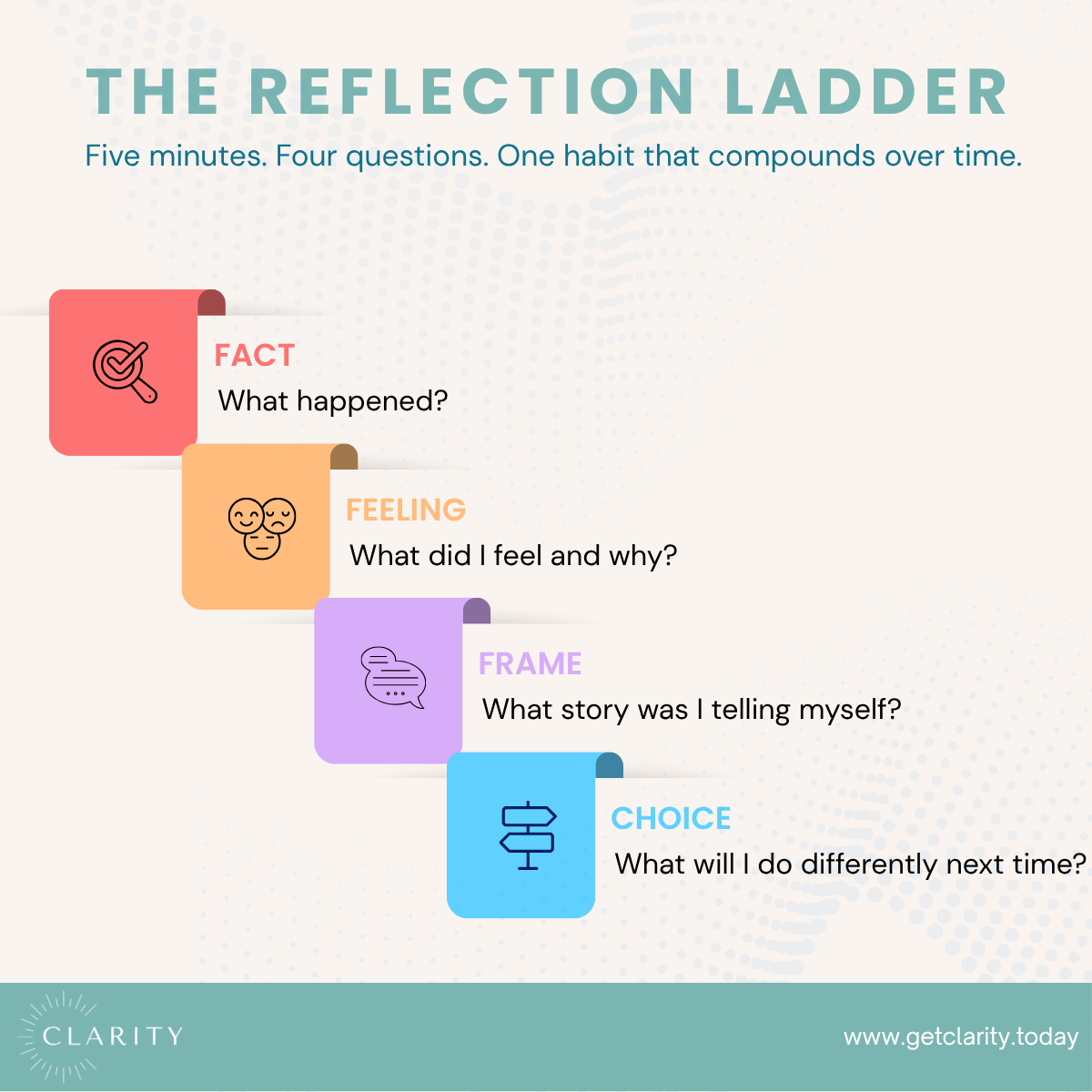
If that sounds familiar — or if you like a bit of structure — take a look at the Reflection Ladder in the image below.
Five minutes. Four questions. One habit that compounds over time.
Because the truth is, we don’t always need more time, advice or certainty.
We just need to pause long enough to hear what our own experience is already trying to tell us.